Showing posts with label Jay Althouse. Show all posts

Monday, July 1, 2013

Beginner Repertoire: Folk Songs

A note about beginners:  I am using beginner to mean an average beginner high school age or older that does not have the vocal challenges of pitch matching, limited range, etc.  I do use these with some of the more musically advanced middle school students.  

Many of us would agree that folk song arrangements are a wonderful way to begin classical voice instruction.  Folk tunes, for the most part, are simple and easy to learn.  I use the folk song arrangements of Copland, Britten, and Quilter with my students, but usually loan these to students rather than having them purchase the books because not all of the songs in the collections are good for young students.  Especially with the Britten, the accompaniments are often difficult and clash with the melody rather than supporting the singer.  I will mention this again in the post on octavos, but if you like the Copland Old American Songs, you should know that many of them are available as unison octavos.

I should also explain that although spirituals offer many of the same benefits of folk songs, I will not be including them in this series.  I teach spirituals, but since I teach at a public school, it's easier, and I feel safer, to just have students sing the spirituals that are included in other collections, rather than buying an entire book of songs about God and spending the whole year with that.

Alfred publishes most of the folk song books that I have my students purchase.  All of these books could be used with men or women, although some songs seem more appropriate for one gender or the other.  All of the Alfred folk song books come in Medium High and Medium Low keys.  Folk Songs for Solo Singers Vol. 1 is also available in a High Key.  I don't have students buy it often, but sometimes I will pull it out and play from it to challenge a student that has the Medium High key and is capable of the higher range and tessitura.  Last I checked, they are all available either as book/CD combo or just the book.

Jay Althouse has been involved in the production of all of these books that I an sharing with you today, serving as composer, arranger, compiler, editor, or some combination of those.  You can read about Jay Althouse's newest book Songs of the British Isles for Solo Singers on this post about my most recent music purchases.


Folk Songs for Solo Singers, Vol. 1 was my first introduction to Jay Althouse.  He compiled and edited this volume, and it also contains four of his own arrangements including his arrangement of Marta Keen's "Homeward Bound".  My student love this song.  I've even had a few choose to bring it back for senior recital.  They love it because the words speak to them.  I love it because it give us the opportunity to work on numerous technical challenges including long breath phrases and starting the phrase on a high note.  Students are also drawn to familiar titles in this book like "Amazing Grace", "Danny Boy" and "Scarborough Fair".


Folk Songs for Solo Singers, Vol. 2 includes the ever popular "The Water is Wide" and "Shenandoah".     I have many books with arrangements of these songs, but as far as I'm concerned, you can't have too many settings of this.  In fact, having several students sing the same tune, but different arrangements not only adds variety to my schedule, it also creates the opportunity for great discussions at studio classes as we explore why a particular arranger chose to interpret the song that way.

Sometimes I think I prefer Ruth Elaine Schram's "Go 'Way from My Window" to the John Jacob Niles setting.  The added material between the verses and the key change makes it more interesting.  I also use her setting of "All Through the Night" with many of my students.  It makes a great first song because the AABA form makes it easy to learn the melody.  I also love "He's Gone Away", but I've had fewer students that loved it as much as I do.  The men I've had purchase this book tend to like "Cindy", "Follow the Drinking Gourd", and "Fire Down Below" the best.  I really like "Poor Boy", but usually the men that do are ready for something more challenging, so I don't teach that one a lot.


For the student who loves foreign languages but is not really read for Schubert and Faure or even the 24 Italian, I highly recommend International Folk Songs for Solo Singers.  My students who are taking Spanish in school love "Valencianita" and "A la Nanita Nana".  From Spanish, it's not too difficult to make the transition to Italian and "Cara Mamma" or "Santa Lucia".  I like the German and French tunes, but I have few students studying those languages, so I don't teach them as much.  There are also a few songs in English here and all the foreign language songs have singable English translations.  Each song also comes with a pronunciation guide which seems to work well for most students, but messes with my head because I am so used to IPA.


Sally K. Albrecht compiled and edited 12 Folk Songs for Solo Singers.  I'm very glad that I picked up this book to review it today, because I was reminded that it contains a Korean folk song, "Arirang".  I have a student who is into all things Korean and I think she will love this.   For those of us that aren't fluent in Korean, there is a pronunciation guide, and students also have the option of singing it in English if they prefer.  This song also has an optional flute part.

"By Waters Clear and Flowing" uses the same tune as "I Gave My Love a Cherry", which I will write about later.  I love the tune, and students seen to connect with these words better.  16th note scale passages in the piano create the feel of running water, but may be difficult for less experienced pianists.

Another favorite from this book is "Johnny's Gone" by Mark Hayes which combines "I Know Where I'm Going" and "Johnny Has Gone for a Soldier".  "Land of Our Dreams" with a tune based on an Armenian lullaby with new words by Hope Harrison is a song about immigrants coming to America, and makes me think of my great-grandmother's journey from Russia in the early part of the 20th century.


American Folk Songs for Solo Singers is a collection of 13 songs all arranged by Jay Althouse.  Many of these titles like "How Can I Keep from Singing", "My Lord What a Morning", "Shenandoah", "Simple Gifts", "Sometimes I feel Like a Motherless Child", and "The Water is Wide" are tunes that I have in other books, but I love the fact that it has so many of my favorites in one place.  "Nine Hundred Miles" was a new tune for me, and one that I ended up liking very much.  It's in a minor key and starts with do me sol (or la do mi if you use la based minor), so it's a great one for reinforcing that pattern with students.


Hal Leonard's contribution to folk songs for young student singers is 15 Easy Folksong Arrangements for the Progressing Singer.  Available in both High and Low keys, this book comes with a CD of full performances of the songs in addition to accompaniment tracks.  It also includes a paragraph of notes about each song.  I really like this because I think it is important for students to learn about where the music comes from.  In fact, sometimes I'll even read students the notes from this book if they are singing a different arrangement from another book.

Brian Dean's arrangement of "I Gave My Love a Cherry" was my first introduction to this beautiful tune.  His simple and easy to play accompaniment doubles the melody for the first two verses.  I also really like Christopher Ruck's arrangement of "The Water is Wide" set in 3 instead of in 4 as we often hear it.  Bryan Stanley makes "Greensleeves" easier for the young student by omitting a note in the melody mid-phrase allowing the student to get a breath.  Now the student has time for a breath after the word "wrong" rather than having to get all the way to "discourteously" before the first breath.  My favorite setting of "Drink to Me Only With Thine Eyes" will always be Quilter's, but this arrangement by Brian Dean is a close second.  However, care must be taken by the accompanist to keep the the piano part light and gentle, especially in the first verse where the accompaniment is mostly in the octaves below middle C.

The next blog post with cover other books at this same level of difficulty that work for both men and women.

Sunday, June 23, 2013

New Music for the Young Voice

This is the first in a series of posts on vocal repertoire for young singers.  I also give workshops covering this material and how to select the best repertoire for each individual student.  You can contact me at robinejm@msn.com if you are interested in hosting a workshop.  

I teach in a public high school.  In most of my 15 years there, I've had a very full studio of 60-100 students with varying levels of ability.  Some of my students couldn't match pitch and some of them were on track for becoming professional musicians.  I had one extremely smart and talented student that came to me a few weeks into 9th grade to explain that she didn't like the song she was working on.  I had assigned a beautiful, but slightly challenging folk song, so I was expecting to hear that she didn't want to sing classical and wanted to work on the latest Brittney Spears song.  Boy was I wrong.  She wanted an art song in a foreign language.

How I wish that was the usual conversation I have with my students about repertoire!  However, that is not the case.  Most have had little if any exposure to classical music.  If I jump right into the 24 (or 26 or 28) Italian Songs and Arias, or even English or American art songs, I lose some of them.  So I am always on the lookout for "user friendly" music that I can use to teach my students classical technique and introduce them to the world of classical music without seeming so strange and foreign to them.

Another challenge I face teaching young voices is that many of them, especially the men, have limited ranges (although sometimes their range is less limited than they believe.) So my search for new music also includes looking for music with the right range (between a 5th and an octave) in the right key.  I have become an expert at music for the young voice and I'll explore more of my finds in future posts.  Today, I will focus on my newest finds.

Since finding songs for high school men is often difficult, let's start there.


Songs of the Wayfarer by Victor Johnson was the first of several books I found from Heritage Music Press.  (Thank you Nicole Marschall for this recommendation!) Until this year, I didn't even know that they had solo books.  Like BriLee and Alfred, Heritage Music Press has taken some of their best choral octavos and presented them in solo song form.  (The books I cover today may also included songs specifically written or arranged for these solo books.) I fell in love with these songs the first time I sang through them.  They are beautiful and sensitive and very much the type of thing that I could use with a young singer who will move on to the classics, but isn't quite ready for that challenge yet.  The book is available in Medium High and Medium low and the accompaniment CD contains both keys, so if you started a student out in the lower book and then the top got freer, he could easily switch over by just practicing with the high key recording.  The only drawback to this book is that most of the songs in the low key still go up to D or Eb and that is too high for most of my 9th grade baritones to do comfortably.


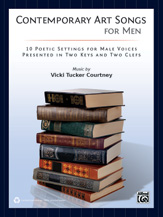
Contemporary Art Songs for Men by Vicki Tucker Courtney is a great option for my young men who may have a limited vocal range, but are also musically sensitive.  These are truly art songs.  I love the music of Jay Althouse, Mark Hayes, and Mark Patterson, but their music, and the music of many of the composers I use for young singers clearly says "educational" to me.  It is beautiful and "user friendly", but not something I would add to a professional repertoire list.  I believe that Vicki Tucker Courtney has what it takes to bridge the divide between teaching songs and true art songs.  These songs mostly have ranges of about an octave, with a few songs at a 5th or 6th.  Within this limited range, and using melodies that are fairly easy to learn, she creates something amazing.

Another bonus of Contemporary Art Songs for Men is that it comes with both keys in the same book, and like Songs of the Wayfarer, the CD also has both keys.  The recordings for both books are very expressive without using so much rubato that the students get lost (which is a common complaint of one of my colleagues who uses books with CDs a lot.)  One final note on these two books for men--if you have a female student that wouldn't have issues with carrying around a book with the words "for men" or "for the developing male voice" plastered on the front, I would recommend these books for girls too.  A few songs might not work, but many are not really gender specific.  I'm planning to sing a set from Contemporary Art Songs for Men for our faculty recital.

The next group of books are not gender specific, but I will probably end up using them more with my women than with my men.  These are books I didn't know about because my local music store doesn't keep them on the shelves with the other vocal solo music. After I found Songs of the Wayfarer, I explored the Heritage Music Press site for more vocal collections.  They have a few books that contain songs from several composers, but since I had limited funds, I chose to first get the books by a single composer since I know and love many songs by these women.


High on my list of things to buy was Sherri Porterfield's My Heart Shall Rejoice.  I've been using the octavos of "Something Told the Wild Geese" and "The Fly Away Horse" with students for several years, just crossing things out or drawing arrows to show them where the melody was.  I was excited to see these available as solos, and for $9.95 I would have purchased the book even if everything else in it was garbage, but I am please to say it's not.  I've already sent a student to purchase this and she loves the songs.  And that is saying a lot since she is one of my kids that wants to sing more pop.   It comes in High Voice and Low Voice and you can purchase a CD separately.  I just wanted to explore the book, so at this point I just have the Low Voice book, but the high voice is on my to-buy list.


Ruth Elaine Schram is another name I was familiar with both from octavos and her songs published in books by BriLee and Alfred.  I will admit that Dreams and Reflections was not a book that I immediately fell in love with, but I do like these songs.  I'm interested to see how the students respond to this book.  This book comes in Medium High and Medium Low keys and only as a book/CD package.


I knew less about Mary Lynn Lightfoot's work, so purchasing And This Shall Be For Music was a risk, but one that I'm glad I took.  "How Beautiful is the Rain" has been stuck in my head all week. (I'm in MN and it seems like we've had maybe 15 hours of sunshine in the last two months, so maybe that's why.  I'm trying to love the rain.)  But seriously, it is a great song and uses a rainstick which might be kind of fun for the recital.  The settings of "Pie Jesu" and "Dona Nobis Pacem" allow students with this beginner book to also explore some easy foreign language texts.  And I can never have too many settings of "How Can I Keep from Singing".  This book comes in Medium High and Medium Low keys and only as a book/CD package.


The last book I will cover today for beginners is the latest publication by Jay Althouse, Songs of the British Isles for Solo Singers.   Available in Medium High and Medium Low keys, this book can be purchase with or without the accompaniment CD.  When looking at the table of contents, you might say, "But I already have arrangements of Scarborough Fair, The Water is Wide, and Skye Boat Song by Jay Althouse in other books.  Why do I need this?"  But these are different, and well worth the purchase price.  I'm a huge fan of Folk Songs for Solo Singers Vol. 1, which was my first introduction to Jay Althouse, but in my opinion, he just keeps getting better and better.  These accompaniments are richer and fuller.  They also ask the singer to be a little more independent, so for my students that struggle, I still may go with the arrangements from some of his other books.  In addition to the songs already mentioned, you will find lovely arrangements of some of my other favorites like "Flow Gently, Sweet Afton",  "The Ash Grove", and "Danny Boy".  This book also includes 2 Christmas songs, and "God Rest Ye Merry Gentlemen" is unlike anything you have heard before.  I love it.


And finally, to wrap things up, new and exciting changes for those singers that you do think will be loving art songs and foreign languages.  Joan Frey Boytim's popular First Book series is now available with Parts I, II, and III all in one volume.  The prices vary on Amazon from time to time, but right now the soprano book is only $27.95 and qualifies for free shipping.  At that price, I have no trouble asking a student to buy the book since there are over 90 songs of varying difficulty in multiple languages.  I could easily see a student using this book and only this book for all of their high school voice lessons.  I still may supplement with other sources, but what a fantastic deal on the literature that will be the foundation of their study.  And for teachers who are still building their own libraries, this is definitely the way to go.


Another great resource for teachers is 28 Italian Songs and Arias Complete with all 5 keys in one book.  I don't see me sending many students to get this, but it sure would have been nice when purchasing those books for the school and for my own personal library.

Have you used any of these books?  What new finds have you recently added to your library?  Comments and discussion are always welcome.