Showing posts with label BriLee. Show all posts

Friday, August 9, 2013

Song of the River

I actually have my wonderful friend and colleague Kari Douma to thank for discovering Mark Patterson's "Song of the River" and the BriLee publication My Heart Sings that also contains this song.   She used it with one of her choirs, and since then I've had many students choose to work on this song.

Mark Patterson wrote new words to the tune of "Salley Gardens."  Like "Give Me Wings," this is a text that young students easily relate to.  I love the beautiful, flowing accompaniment.  In addition to being in a very singable range for most young voices (just over an octave), this song gives me many opportunities to teach both theory and vocal technique.

  • The first thing I talk about with students even before we sight-read the piece is that this song is in AABA or song form.  I point out the patterns, and the places that those patterns vary slightly.  Because they recognize that pattern, by the time we get to the last A phrase of the 2nd verse, they are singing with confidence and I can tell if the song is going to be one that will work well for them.  
  • The B phrase gives me an opportunity to work on high notes. It begins with a Do to Sol jump, and ends with an almost step-wise progression to the high Re, so in one simple phrase I learn which approach is easiest for the student, and I can also give instruction on making both approaches easier.  
  • In the first verse, the melody is almost always doubled in the accompaniment, providing a little more security for the student early in the learning process. After that, the accompaniment has more variation, and although the piano part gives harmonic support, the student must be fairly confident to hold on to the part.  
  • Phrases are mostly 4 measures, but commas mid-phrase allow for extra breaths if needed.  I use this song to talk to students about how to decide where to breathe if you can't make it to the next rest or editor's breath mark.  
  • The song ends with a slowed down repetition of the last phrase.  Although it is not pure augmentation (everything doubled exactly), I do introduce the student to that concept.  
"Song of the River" is available as an octavo (in both Unison/Two-Part and SATB settings) and in the book My Heart Sings.  The song is in the Key of D in both the octavo and the book.  

Sunday, June 30, 2013

Exploring Vocal Repertoire: Baby Beginners Part 3 (Young Women)

In the last post, I wrote about the three books published by BriLee for the male changing voice.  Today, I will be covering their two books for the developing treble voice.  I guess technically, that could be a young boy whose voice has not changed yet, but I use these primarily for my middle school girls and for beginning high school females.

Like the books for male changing voice, these books include repertoire that is lower and of limited range, as well as songs that move the singer towards freedom in the upper range.  Most importantly, my students like these songs.  Both books come with CDs that have both demo and accompaniment tracks.

My Heart Sings includes 10 songs composed or arranged by Mark Patterson.  There is not a song in this book that I don't like.  "If" and "Send forth a Song" are great songs for those students who have not yet learned how to shift out of chest voice and therefore think they can't sing above A.  With just a few Bs and Cs, these songs help students feel comfortable and stretch their boundaries at the same time.

In "Song of the River" Patterson adds his own beautiful words to a tune that most voice teachers know well, Salley Gardens. This is another favorite among students.  The melody is doubled by the piano in the first verse, but not in the second, so young singers get a chance to test their independence.

"The Violet" is another favorite among students.  Because they love it, they are willing to work to get the F's.  The F is approached both as an octave jump and by steps up moving through D and E to get to the F.

 
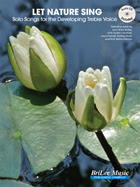
Let Nature Sing is a book of  10 songs for women by women.  I was pleased to find Ruth Elaine Schram's "The Song that Nature Sings" in this book.  It is in one of the books for the male changing voice and I've been using it the choral octavo with my women because I've had very few students of either gender that don't like this song.

Laura Farnell adds text and a new melody to an old favorite, "How Can I Keep From Singing."

Lynn Shaw Bailey's arrangement of "Sometimes I Feel Like a Motherless child" adds a new section that I was not familiar with, so it may have been written just for this.  The two verses we are used to hearing are followed by this new section and then a return to the first verse, fleshing out what is often a very short song and creating AABA form.  And yes, I do talk to my students about form all the time and there are many, clear examples of AABA form in these books.

Ruth Elaine Schram has multiple arrangements of "Oh Shenandoah."  I ordered the octavo thinking I would be getting the arrangement in this book.   I was disappointed to see that they are not the same, but I do like them both and teach both arrangements.

One of my favorite songs in this book is "Pure, White Owl" with words and music by Earlene Rentz.  The point in the music where she sees the bird actually sounds like soaring.  We hear the awe at the beauty of this chance sighting.

Now that we've laid the foundation with music for the youngest singers or singers with a few challenges, we'll move on in the next post to the what I will refer to simply as beginners.